
Return to the Frank Passic
Any photos not otherwise credited are from the personal collection of Frank Passic, Albion Historian.
|
Morning Star, March 27, 2026, pg. 5 You can read more details about this topic and about other Albion banks in my 1985 book "Albion's Banks and Bankers," now out-of-print. Copies are available at area libraries. One fascinating aspect of all National banks is that they were charged with issuing currency (paper money) bearing the name of the local bank, but the notes were printed and backed by the U.S. Treasury. The bank notes were good anywhere across the U.S. This is because bonds were deposited into the U.S. Treasury by each bank to "cover" for the value of the bills printed. Here in Albion, the National Exchange Bank issued $48,500 worth of "First Charter" $5 bills (9,700 notes), with local serial numbers ranging from 1 through 2425. $30,000 worth of $10 notes (3,000 notes) and $20,000 worth of $20 notes (1,000 notes) were printed, bearing serial numbers 1 through 1,000. These were hand signed at the bottom by the bank cashier and the bank president. These were large size bills, too, measuring 7 +3/8 by 3 +1/8 inches, about 30% larger than today's currency. The upper portion of the notes bear the red U.S. Treasury seal, the facsimile signatures of the Treasury officials, as well as a red national serial number. Another issue called the Series of 1875 was also printed and distributed consisting of $16,500 worth of $10 bills (1,650 notes), and $11,000 worth of $20 bills (550 notes), with local serial numbers of 1 through 550. One of these issued Albion bank notes is known to have survived. (Other than printer's specimens in the Smithsonian Institute in Washington, D.C.) In 2013, a First Charter original $10 note from the National Exchange Bank of Albion was listed in the Heritage Auctions Long Beach California Auction #3524, Lot No. 116001, where it was sold on September 25 to an unknown purchaser (not me, unfortunately). This note is graded just "Fine-12," (pretty much worn) but, hey, it's unique, meaning it is the only one known to have survived. From our Historical Notebook this week we present the photograph of this unique note as pictured in the Heritage auction catalog. The name of Albion's bank is in the center. The bank charter number "1544" appears twice: Vertically on the left, and horizontally on the right, both in red ink. The local bank serial number, "268" appears in the far left under the scene of Benjamin Franklin drawing electricity from the key via his kite. Bearing such a low serial number of 268, this is definitely from the "first batch" of notes issued by the bank 1866. In the lower left, the hand-inked signature of the bank cashier, "G.W. Davis" can be faintly seen in the lower bottom, while the signature of the bank president S.V. Irwin is mostly faded from view in the bottom right. The back of the note depicts DeSoto discovering the Mississippi River. As notes became worn, they were turned in and shipped back to the U.S. Treasury where they were destroyed, giving the bank credit for each bill returned. Records show that by 1910, only $942.50 still remained in circulation. The odd amount would be for a $5 note that was torn/missing and only $2.50 credit was given for that note. By the way, National bank notes were also issued by National banks in Jackson, and the one in Concord, too. How many of our readers have ever seen any National bank notes? 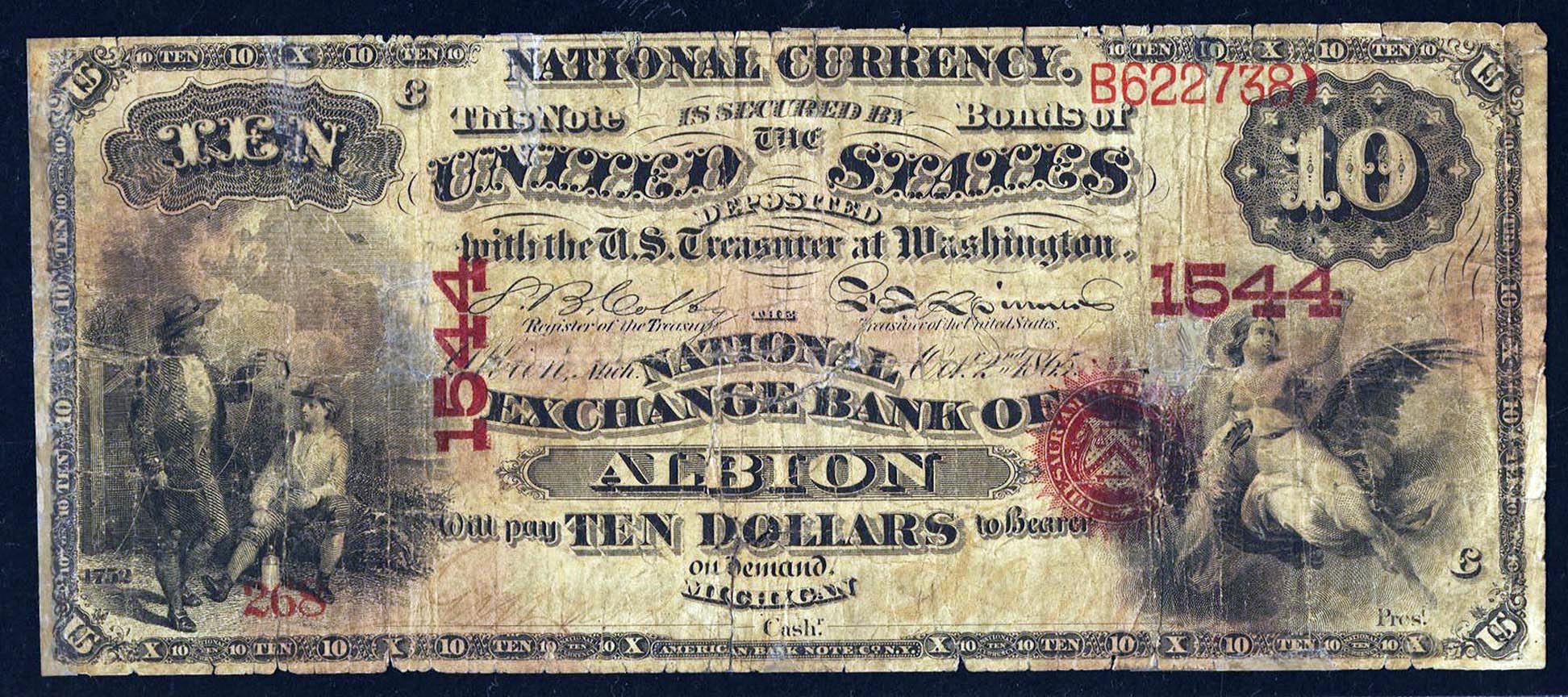 As pictured in the Heritage auction catalog.
All text copyright, 2026 © all rights reserved Frank Passic | Artwork copyright Maggie LaNoue © 2026
| |