
Return to the Frank Passic
Any photos not otherwise credited are from the personal collection of Frank Passic, Albion Historian.
|
Morning Star, February 27, 2026, pg. 8 Theodore was induced to move his manufacturing firm to Albion by local businessmen, who assured Mr. Prouty of the larger facility opportunities located here, and the excellent transportation. Local leaders also raised $55,000 to purchase company stock, which helped the company erect and remodel its headquarters here. The Prouty Company was located in the building formerly occupied by the Keenan and Hess Manufacturing Company, a foundry which had produced gray and brass castings here since March, 1894. It was located on the east side of N. Clark St. outside of the city limits, just south of the Lake Shore & Michigan Southern Railroad tracks. The plant employed between 50 and 100 persons. Alvin Dice served as cashier of the firm, while Milo VanEpps was superintendent. Clarence Messacar served as shipping clerk and traffic manager. The Prouty Company manufactured locks, and roller-bearing sliding door mechanisms for barns and living room doors. The Prouty locks became especially popular for use on barns, sheds, and homes. The lock portion measures approximately 2 1/2" in diameter. There is a metal bar (hasp) about 5 1/2" long attached to it, with a hole on the left to affix a bolt. The loop fastener slips into the center of the lock. When pressed, a small button click releases a locking mechanism through the loop, thus locking it. In order to unlock the mechanism, a key was used. The Prouty Company merged with the Allith Manufacturing Company of Chicago in 1912, and moved to Danville, IL (located about 120 miles south of Chicago) under the new name of the Allith-Prouty Company. It was located at 819 N. Bowman Ave. There it became a major producer of hardware items and sliding door parts. Their foundry was known as the Danville Malleable Iron division, where castings were produced. The Allith-Prouty Company continued in operation until it closed in 1981. The former Prouty site in Albion was acquired by the Hayes Wheel and produced wheel hubs during the 1910s and 1920s. In the 1930s, the location became home to the Lonergan Manufacturing Company, and subsequently, the McGraw-Edison Co. Mr. Prouty left his company in 1905 to join the Wilcox Manufacturing Company of Aurora, Il, where he remained until 1918. At that time, he moved to California and specialized in the art of ceramics. In 1921 he founded the Proutline Products Company in Hermosa Beach, CA. Furthermore, in 1927 he established the Metlox Corporation in Manhattan Beach, CA which specialized in ceramic lettering and neon signs. Prouty's 1931 obituary relates about his inventive talents in the field of aviation: "During the World War, Mr. Prouty achieved note as the inventor of several airplane instruments, including the altimeter." He died in Los Angeles on September 8, 1931 and was buried in Inglewood Park Cemetery. Today, Prouty locks are collector's items. They occasionally turn up on old barns or in old farm junk miscellaneous boxes, and on rare occasions, on the E-Bay auction site. Locks with keys are especially hard to locate, and they bring a premium today. From our Historical Notebook this week we present a photograph of a Prouty lock with key. The inscription on the bar states, "T. C. Prouty Co. Ltd. Patents Pending. Albion, Mich. U.S.A." How many of our readers have seen a Prouty lock before, and how many own one? 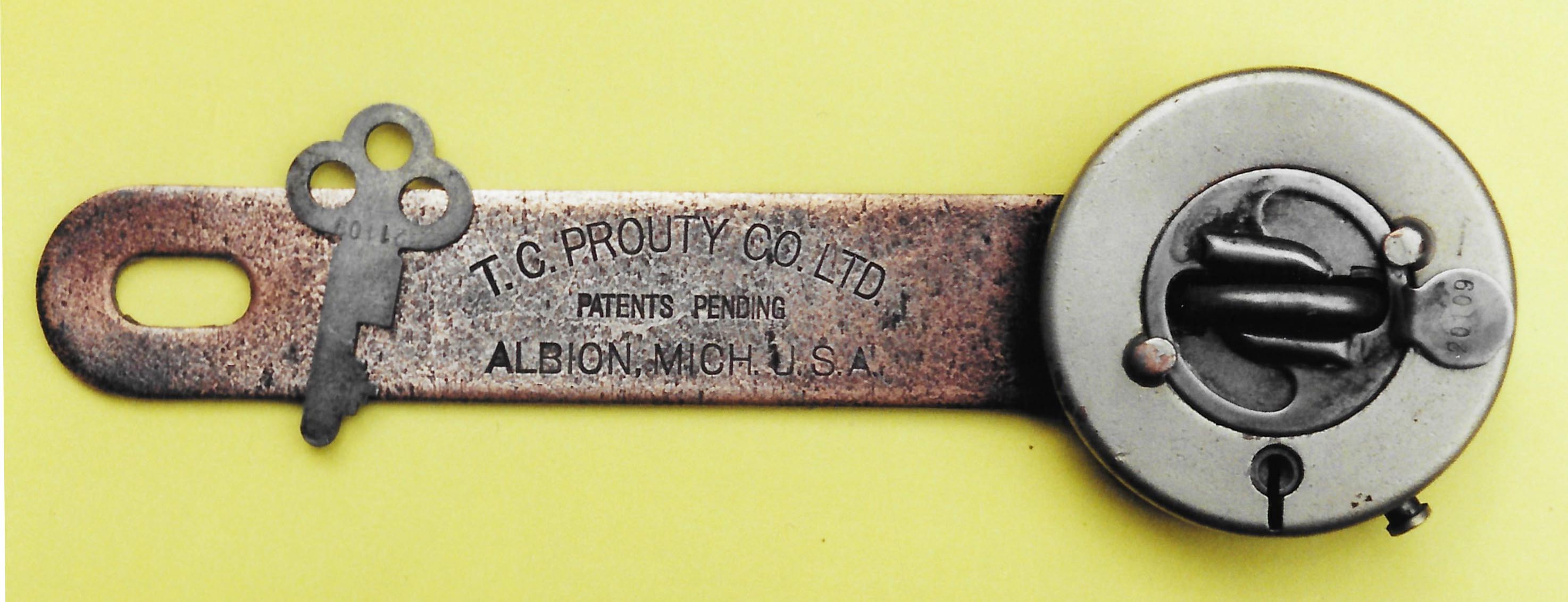 A Prouty lock with key
All text copyright, 2026 © all rights reserved Frank Passic | Artwork copyright Maggie LaNoue © 2026
| |